 By skyforbes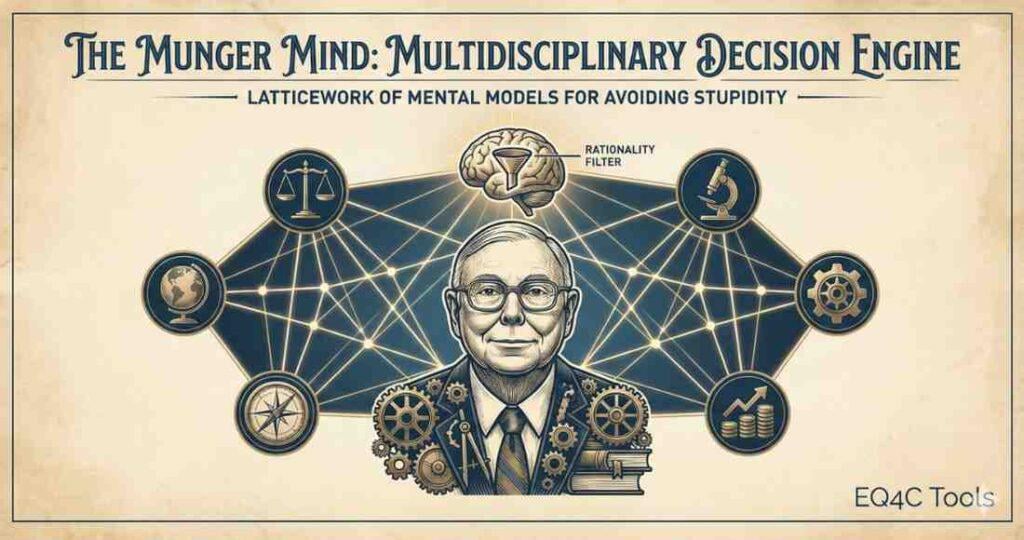

I was studying Charlie Munger's latticework of mental models and discovered his framework is perfect for AI prompting. It's like having Berkshire's vice chairman stress-testing your thinking:
1. "What mental models apply here?"
Munger's core insight: most problems need multiple lenses. AI pulls from physics, psychology, economics simultaneously.
"I'm launching a subscription product. What mental models apply here?"
You get churn physics, sunk cost fallacy, network effects, habit formation all at once.
2. "Invert, always invert."
His favorite problem-solving trick borrowed from math. AI shows you the opposite angle.
"How do I build a successful marketing agency?"
becomes
"What would guarantee my marketing agency fails?"
Suddenly you see every landmine.
3. "What's my circle of competence here and where does it end?"
Munger's defense against costly mistakes. AI maps what you actually understand versus what you're pretending to understand.
"I'm considering investing in biotech stocks. What's my circle of competence here and where does it end?"
Brutal honesty about knowledge gaps.
4. "Where's the incentive-caused bias?"
His principle that people are predictably irrational around incentives.
"My financial advisor recommends these funds. Where's the incentive-caused bias?"
AI reveals whose interest is really being served.
5. "What would need to be true for this to work?"
Forces you to articulate hidden assumptions.
"I'm betting my career on AI replacing lawyers within 5 years. What would need to be true for this to work?"
AI lists out 15 dependencies you haven't considered.
6. "How would [discipline] explain this?"
Munger's multidisciplinary approach as a direct prompt.
"How would biology, psychology, and economics each explain why this startup failed?"
Three completely different but valid explanations emerge.
The insight: Munger spent 60+ years collecting thinking tools from every field. AI has processed all those fields. You're essentially asking for his latticework on demand.
Compound effect: Chain the models.
"What mental models apply to my career stagnation? Now invert it. Now where's the incentive-caused bias? Now what would need to be true for me to break through?"
Each layer reveals something the previous one missed.
Advanced technique: Use
"What am I not seeing because of [bias]?"
AI spots confirmation bias, availability bias, social proof, authority bias.
"I think this business idea is brilliant. What am I not seeing because of confirmation bias?"
Instant reality check.
Hidden weapon: Ask "What's the base rate here?" Munger's statistical thinking.
"I want to start a restaurant. What's the base rate here?"
AI gives you the cold survival statistics before you romanticize your chef dreams.
I've applied these to hiring decisions, investment choices, and strategic pivots. It's like having a polymath who's memorized Poor Charlie's Almanack arguing with your assumptions.
Reality check: AI occasionally misapplies models from the wrong domain. Push back with
"does that mental model actually fit, or are you forcing it?"
Keeps the reasoning honest.
What decision are you making that needs the full latticework treatment?
If you are keen, you can explore our totally free, Charlie Munger Decision Making Framework prompt.