 By skyforbes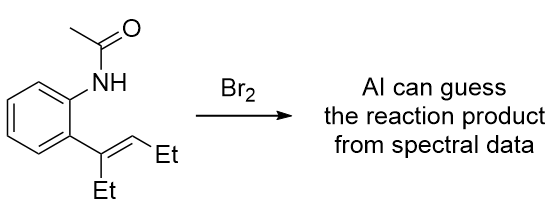

For a long time, I thought the primary application of AI in chemistry was perplexity search (as well as the new Google Scholar Labs). Everything else was either highly specialized (like recognizing nanoparticles in electron microscope images) or not so important (like polishing papers).
A few days ago, I was amazed to discover how well the new Gemini 3 deciphers organic structures from NMR spectra. We had real spectra of unexpected products that several of us, highly qualified chemists, spent half a day deciphering. Gemini does it in minutes.
This reminds me that deciphering molecular structures using X-ray diffraction was once a complex intellectual endeavor. With the advent of algorithms, this task has become routine. I suspect that within 5 years (allowing for the inertia of chemists' thinking), a similar thing will happen with NMR decoding. Humans will still be better at solving complex problems, but routine spectra will be immediately uploaded to systems like Odanchem.org to get the most probable formula.
So, I recommend every organic chemist to use AI for NMR spectra decoding – it really works.
As an example, here is one of the problems solved by Gemini:
Try to decipher the structure of an organic product from its NMR spectrum. The starting material, 3-(ortho-acetylamino-phenyl)-hexene-3, reacted with bromine. The product spectrum is as follows:
1H NMR (400 MHz, Chloroform-d) δ 7.40 (m, 2H), 7.33 (m, 2H), 4.07 (t, J = 7.0 Hz, 1H), 2.39 (m, 1H), 2.29 (m, 1H), 2.20 (s, 3H), 1.91 (m, 1H), 1.94 (m, 1H), 1.06 (t, J = 8.0 Hz, 3H), 1.00 (t, J = 8.0 Hz, 3H).
No other signals are present. According to the mass spectrum, the molecule contains only one bromine atom.
This reaction has not been published in the literature.