 By skyforbes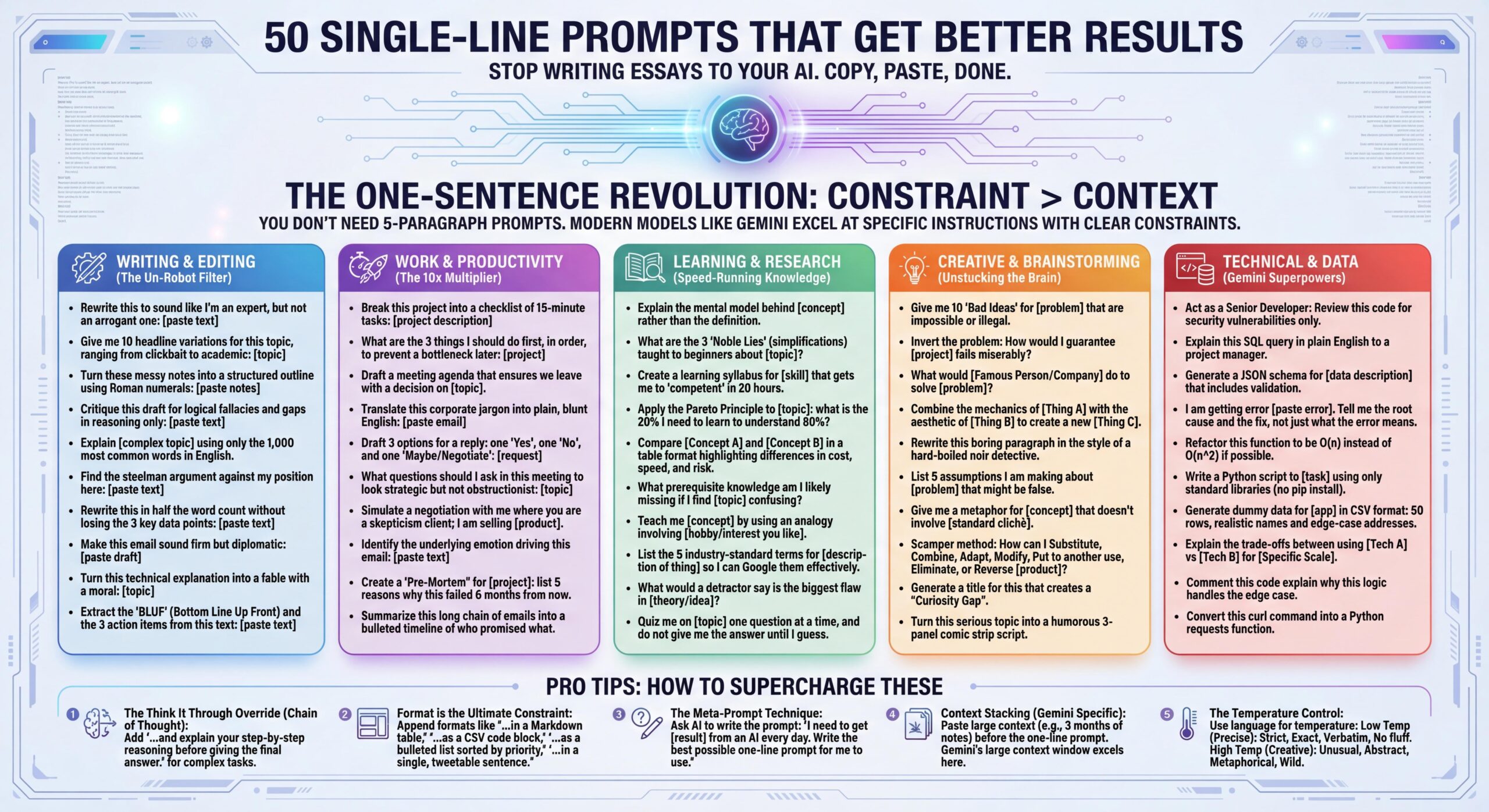

I found that Constraint > Context. Telling the AI what not to do or exactly how to format it is often more powerful than giving it a backstory.
Here is my collection of One-Liners. The rule is simple: One sentence max. No follow-ups needed.
WRITING & EDITING (The Un-Robot Filter)
- "Rewrite this to sound like I'm an expert, but not an arrogant one: [paste text]"
- Why it works: Fixes imposter syndrome and corporate jerk vibes simultaneously.
- "Give me 10 headline variations for this topic, ranging from clickbait to academic: [topic]"
- Why it works: Forces the model to explore the full spectrum of tone.
- "Turn these messy notes into a structured outline using Roman numerals: [paste notes]"
- Why it works: Gemini loves structure; this forces order on chaos.
- "Critique this draft for logical fallacies and gaps in reasoning only: [paste text]"
- Why it works: Stops the AI from complimenting your grammar and makes it focus on the argument.
- "Explain [complex topic] using only the 1,000 most common words in English."
- Why it works: The ultimate clarity test (inspired by Randall Munroe).
- "Find the steelman argument against my position here: [paste text]"
- Why it works: Steelman is the opposite of Strawman. It forces the AI to build the strongest possible opposing view.
- "Rewrite this in half the word count without losing the 3 key data points: [paste text]"
- Why it works: Shorten this is vague. Half the word count is a hard constraint.
- "Make this email sound firm but diplomatic: [paste draft]"
- Why it works: The perfect tone for saying "No" to a client.
- "Turn this technical explanation into a fable with a moral: [topic]"
- Why it works: Great for presentations or explaining tech to non-tech stakeholders.
- "Extract the 'BLUF' (Bottom Line Up Front) and the 3 action items from this text: [paste text]"
- Why it works: Military precision for long emails.
WORK & PRODUCTIVITY (The 10x Multiplier)
- "Break this project into a checklist of 15-minute tasks: [project description]"
- Gemini Optimization: Gemini is great at logic; this kills procrastination by lowering the barrier to entry.
- "What are the 3 things I should do first, in order, to prevent a bottleneck later: [project]"
- Why it works: Prioritization based on dependency, not just urgency.
- "Draft a meeting agenda that ensures we leave with a decision on [topic]."
- Why it works: Focuses the meeting on output, not discussion.
- "Translate this corporate jargon into plain, blunt English: [paste email]"
- Why it works: Helps you understand what your boss is actually saying.
- "Draft 3 options for a reply: one 'Yes', one 'No', and one 'Maybe/Negotiate': [request]"
- Why it works: Gives you a menu of choices immediately.
- "What questions should I ask in this meeting to look strategic but not obstructionist: [topic]"
- Why it works: The smartest person in the room cheat code.
- "Simulate a negotiation with me where you are a skepticism client; I am selling [product]."
- Why it works: Roleplay without the setup time.
- "Identify the underlying emotion driving this email: [paste text]"
- Why it works: EQ check. Is the sender angry, scared, or just busy?
- "Create a 'Pre-Mortem' for [project]: list 5 reasons why this failed 6 months from now."
- Why it works: Inversion thinking. It finds risks you missed.
- "Summarize this long chain of emails into a bulleted timeline of who promised what."
- Gemini Optimization: Gemini's large context window eats long email chains for breakfast.
LEARNING & RESEARCH (Speed-Running Knowledge)
- "Explain the mental model behind [concept] rather than the definition."
- Why it works: Teaches you how to think, not just what to know.
- "What are the 3 'Noble Lies' (simplifications) taught to beginners about [topic]?"
- Why it works: Helps you distinguish between introductory concepts and advanced reality.
- "Create a learning syllabus for [skill] that gets me to 'competent' in 20 hours."
- Why it works: Applies the Josh Kaufman method to learning.
- "Apply the Pareto Principle to [topic]: what is the 20% I need to learn to understand 80%?"
- Why it works: High-leverage learning.
- "Compare [Concept A] and [Concept B] in a table format highlighting differences in cost, speed, and risk."
- Why it works: Tables are the best way to make decisions.
- "What prerequisite knowledge am I likely missing if I find [topic] confusing?"
- Why it works: Diagnostics for your own brain.
- "Teach me [concept] by using an analogy involving [hobby/interest you like]."
- Example: "Teach me crypto using an analogy about gardening."
- "List the 5 industry-standard terms for [description of thing] so I can Google them effectively."
- Why it works: Sometimes you don't know the keyword to search for.
- "What would a detractor say is the biggest flaw in [theory/idea]?"
- Why it works: Removes confirmation bias.
- "Quiz me on [topic] one question at a time, and do not give me the answer until I guess."
- Why it works: Active recall study session.
CREATIVE & BRAINSTORMING (Unstucking the Brain)
- "Give me 10 'Bad Ideas' for [problem] that are impossible or illegal."
- Why it works: Removes performance pressure. Often the "illegal" idea has a legal, brilliant cousin.
- "Invert the problem: How would I guarantee [project] fails miserably?"
- Why it works: If you know how to break it, you know how to fix it.
- "What would [Famous Person/Company] do to solve [problem]?"
- Example: "What would Disney do to fix my dentist office waiting room?"
- "Combine the mechanics of [Thing A] with the aesthetic of [Thing B] to create a new [Thing C]."
- Why it works: Forced association generates novelty.
- "Rewrite this boring paragraph in the style of a hard-boiled noir detective."
- Why it works: Extreme style shifts help you find a middle ground voice.
- "List 5 assumptions I am making about [problem] that might be false."
- Why it works: Checks your blind spots.
- "Give me a metaphor for [concept] that doesn't involve [standard clichè]."
- Example: "Give me a metaphor for teamwork that isn't sports or gears."
- "Scamper method: How can I Substitute, Combine, Adapt, Modify, Put to another use, Eliminate, or Reverse [product]?"
- Why it works: Runs a standard design thinking framework instantly.
- "Generate a title for this that creates a 'Curiosity Gap'."
- Why it works: Marketing gold.
- "Turn this serious topic into a humorous 3-panel comic strip script."
- Why it works: If you can make it funny, you understand it deeply.
TECHNICAL & DATA (Gemini Superpowers)
These work best with Gemini Advanced/1.5 Pro due to reasoning capabilities.
- "Act as a Senior Developer: Review this code for security vulnerabilities only."
- Why it works: Specificity prevents generic clean code advice.
- "Explain this SQL query in plain English to a project manager."
- Why it works: Translation between tech and business.
- "Generate a JSON schema for [data description] that includes validation."
- Why it works: Saves 15 minutes of typing boilerplate.
- "I am getting error [paste error]. Tell me the root cause and the fix, not just what the error means."
- Why it works: Skips the definition, goes straight to the solution.
- "Refactor this function to be O(n) instead of O(n^2) if possible."
- Why it works: Explicit performance constraint.
- "Write a Python script to [task] using only standard libraries (no pip install)."
- Why it works: Ensures portability of the code.
- "Generate dummy data for [app] in CSV format: 50 rows, realistic names and edge-case addresses."
- Why it works: Edge-case ensures your app is tested against bad data.
- "Explain the trade-offs between using [Tech A] vs [Tech B] for [Specific Scale]."
- Why it works: Contextual architectural advice.
- "Comment this code explain why this logic handles the edge case."
- Why it works: Auto-documentation.
- "Convert this curl command into a Python requests function."
- Why it works: Instant syntax translation.
Pro Tips: How to Supercharge These
1. The Think It Through Override (Chain of Thought) If a prompt gives you a shallow answer, add this simple tail: "…and explain your step-by-step reasoning before giving the final answer." This forces the model to slow down and use more computation on the logic, which drastically reduces hallucinations in complex tasks.
2. Format is the Ultimate Constraint Never settle for a block of text if you don't want one. Append these specific formats to any of the prompts above:
- "…in a Markdown table."
- "…as a CSV code block."
- "…as a bulleted list sorted by priority."
- "…in a single, tweetable sentence."
3. The Meta-Prompt Technique If you have a recurring task but don't know how to prompt for it, ask Gemini to write the prompt for you: "I need to get [result] from an AI every day. Write the best possible one-line prompt for me to use."
4. Context Stacking (Gemini Specific) Gemini has a massive context window. Don't just paste the one email you are replying to—paste the last 3 months of project notes before your one-line prompt. The prompt stays simple: "Based on the attached context, write a reply." The more boring data you feed it, the smarter the simple prompt becomes.
5. The Temperature Control While you can't adjust temperature sliders in standard chat interfaces, you can simulate it with language:
- Low Temp (Precise): Use words like Strict, Exact, Verbatim, and No fluff.
- High Temp (Creative): Use words like Unusual, Abstract, Metaphorical, and Wild.
What's your One-Liner that never fails? Drop it in the comments.