 By skyforbes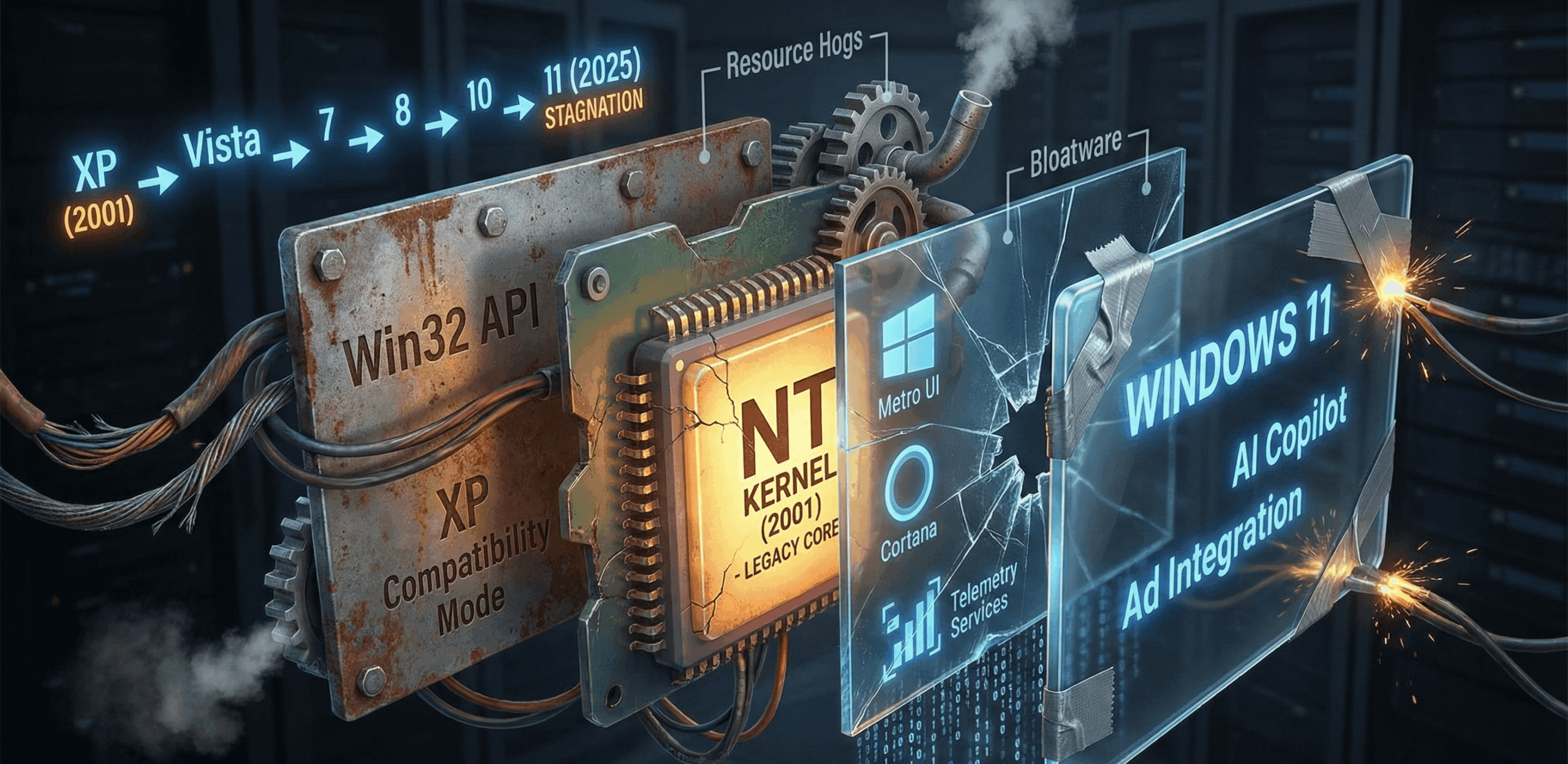

We have gone from XP’s "stable NT unification" to Windows 11’s "Ad-Service with a Kernel." Here is the breakdown of why the architecture is failing us, and why "fixing it" requires more than just a UI refresh.
1. The "Franken-Kernel" Problem (NT 5.1 vs NT 10.0)
Windows XP (released Oct 25, 2001) was a masterpiece of its time because it successfully merged the consumer line (9x) with the stable business line (NT). That was the last time Microsoft truly committed to a cohesive architectural vision.
Since then, they haven't redesigned the architecture; they’ve just wrapped it in more layers of abstraction.
- The Win32 Albatross: Microsoft refuses to break backward compatibility. This sounds noble, but it means the kernel is permanently shackled to API calls from 1995.
- The Scheduler: In 2025, the Windows scheduler still struggles to intelligently manage P-cores and E-cores without causing micro-stutters, something Linux settled years ago.
- Legacy Code: You can still find dialog boxes in Windows 11 that haven't changed since Windows 2000. This isn't just aesthetic; it proves that the underlying subsystems are a patchwork of unmaintained legacy code that no one at Microsoft wants to touch for fear of breaking the house of cards.
2. User-Hostile Resource Management
In my line of work, an OS has one job: Manage hardware resources efficiently to run user applications. Windows has forgotten this.
- Idle Resource Usage: A fresh Windows 11 install consumes 4GB+ of RAM and 50-100 processes at idle. This isn't "caching"—this is bloat.
- The "Service" Economy: Windows runs services that users never asked for (Connected User Experiences, Telemetry, Advertising IDs) that actively fight your applications for CPU time.
- Storage Sense is a Band-Aid: The argument that "Storage Sense" mitigates disk usage is an admission of failure. An OS shouldn't generate 10GB of "temporary" junk and update residues that need a dedicated garbage collector tool to fix. That is bad I/O architecture.
3. The "Product" vs. The "Tool"
The shift from XP to 11 wasn't technical; it was ideological.
- XP (2001): You bought a tool. It sat there and waited for your input.
- 11 (2025): You are renting a storefront.
The OS now treats you as the product. The Start Menu injects ads; the Search bar is a Bing funnel; "Bloatware" isn't just pre-installed junk anymore—it’s system-level integration of social media stubs that regenerate after you delete them.
4. The "Phased Rollout" Excuse
Microsoft often touts their "phased and measured" rollout approach. In the enterprise world, we call this "Beta testing in Production."
They no longer release finished software (RTM). They release a "Minimum Viable Product" and use the user base as unpaid QA testers. This is why critical updates break printing, networking, or SSD performance regularly.
The Verdict
We don't need Windows 12 with rounded corners or AI Copilots. We need what Apple did in 2001 with OS X: A clean break.
We need a modular kernel that discards the registry, sandboxes legacy Win32 apps, and respects the user's hardware. Until then, we are just putting lipstick on a pig that was born in 2001.
TL;DR: Windows hasn't evolved; it has metastasized. It prioritizes legacy support and ad revenue over kernel efficiency and user agency.