 By skyforbes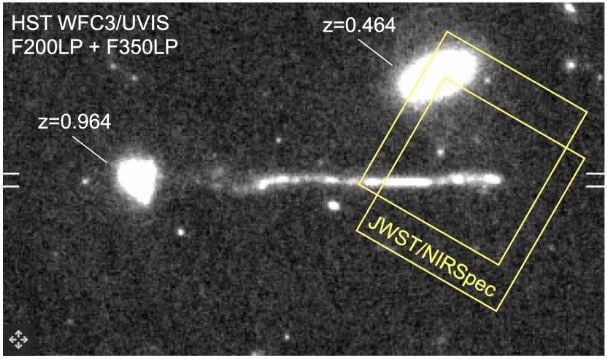

Astronomers have made a truly mind-boggling discovery using the James Webb Space Telescope (JWST): a runaway black hole 10 million times larger than the sun, rocketing through space at a staggering 2.2 million miles per hour (1,000 kilometers per second).
That not only makes this the first confirmed runaway supermassive black hole, but this object is also one of the fastest-moving bodies ever detected, rocketing through its home, a pair of galaxies named the "Cosmic Owl," at 3,000 times the speed of sound at sea level here on Earth. If that isn't astounding enough, the black hole is pushing forward a literal galaxy-sized "bow-shock" of matter in front of it, while simultaneously dragging a 200,000 light-year-long tail behind it, within which gas is accumulating and triggering star formation.
This now-confirmed runaway supermassive black hole was first identified by van Dokkum and colleagues back in 2023 using the Hubble Space Telescope, which spotted what appeared to be the wake of a massive body passing through space. The reason why the object was spotted is because of the impact that the passage of the black hole has on its surroundings: we now know that it drives a shock wave in the gas that is moving through, and it is this shock wave, and the wake of the shock wave behind the black hole, that we see.
With the JWST, van Dokkum's team discovered the huge displacement of the gas at the tip of the wake, where the black hole is pushing against it. The shock signatures are crystal clear, and there is just no doubt about what is happening here. The gas is pushed sideways away from the supermassive black hole at a velocity of hundreds of thousands of miles per hour (hundreds of km per second), a dynamical signature that the team saw with JWST.