 By skyforbes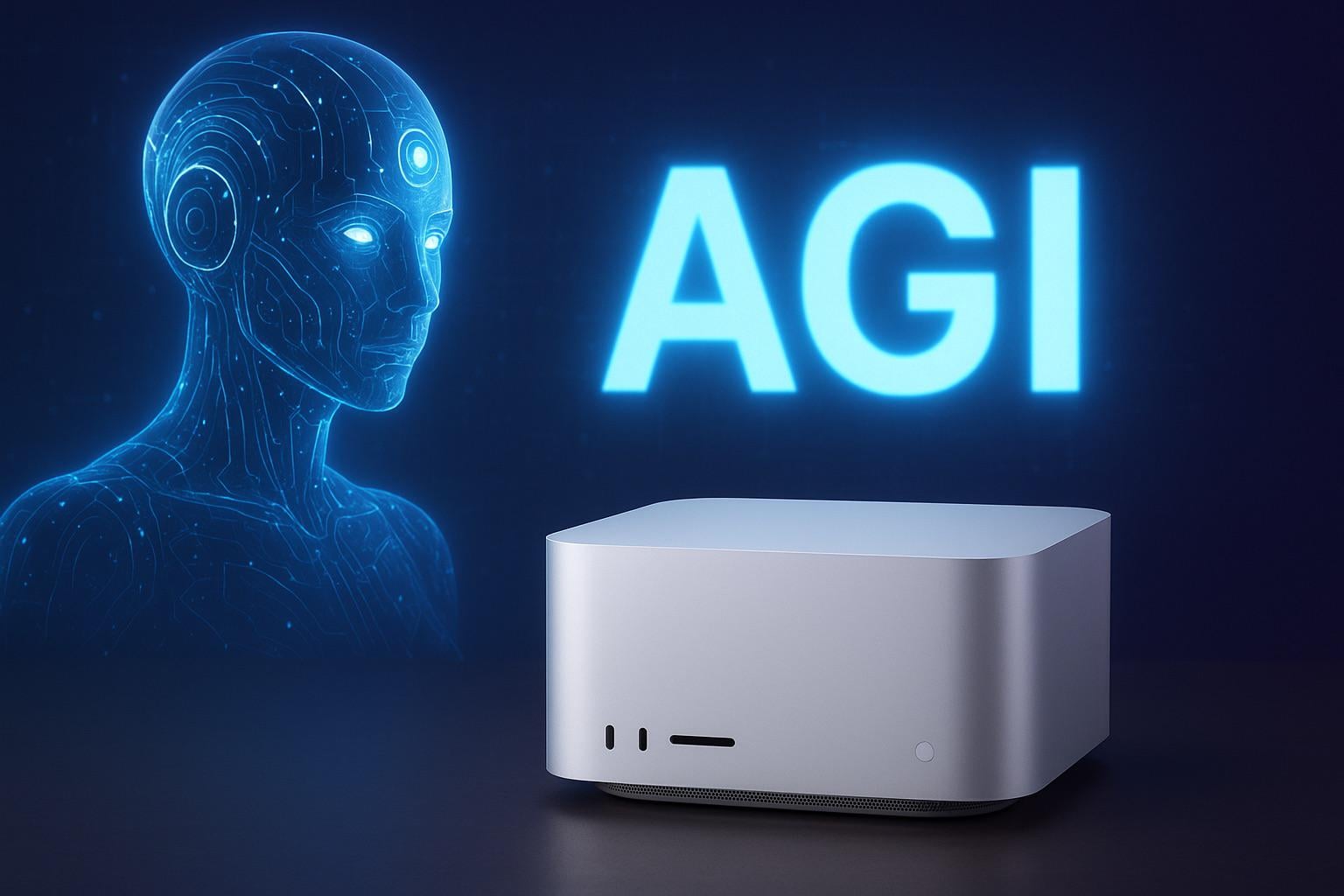

Why the Mac Studio M4 Isn’t Enough to Create AGI — And Was Never Meant To
When Apple released the Mac Studio with the M4 architecture, the industry reacted with justified excitement. The machine is powerful, efficient, and engineered with Apple’s meticulous approach to silicon integration. It pushes the boundaries of what creators, developers, and professionals can do on a desktop-class device.
But as headlines increasingly invoke “AGI” — Artificial General Intelligence — some observers have begun to speculate whether such a system could be a stepping stone toward building AGI inside Apple’s ecosystem.
The short answer: No. The Mac Studio M4 is extraordinary, but it is nowhere near what is required to develop or run true AGI—and Apple is not attempting to position it that way.
Here’s why.
⸻
- AGI Requires Massive, Distributed Compute — Far Beyond Any Consumer Device
Modern AI models at the frontier require:
• Hundreds of billions to trillions of parameters
• Thousands of GPU accelerators working in parallel
• Data center–scale memory and bandwidth
• Megawatts of power consumption
Meanwhile, the Mac Studio M4, even if exceptionally optimized, is:
• A single-node workstation
• Designed for efficiency, not raw cluster-scale throughput
• Limited to the thermal/power envelope of a consumer desktop
• Equipped with a Neural Engine optimized for on-device inference, not training models at AGI scale
Developing AGI requires compute centers that look more like supercomputers, not studio desktops—even very fast ones.
⸻
- The Neural Engine Isn’t Designed for AGI-Scale Training
Apple’s Neural Engine (ANE) excels at:
• On-device inference
• Real-time enhancement for images, audio, and video
• Efficient ML tasks with low latency
But AGI-level models require:
• Distributed training frameworks like PyTorch/XLA, DeepSpeed, or JAX
• High-bandwidth interconnects (NVLink, Infiniband)
• Specialized GPU/TPU-like architectures
The ANE is brilliant for everyday ML tasks, but it is not architected for multi-trillion-parameter parallel gradient descent.
⸻
- Apple’s AI Strategy Is On-Device Intelligence, Not AGI Research
Apple’s public-facing AI direction emphasizes:
• Privacy-preserving, on-device intelligence
• Contextual features across macOS and iOS
• Personalized assistance without cloud dependency
AGI, by contrast, requires:
• Centralized cloud-scale training
• Massive data aggregation
• Research infrastructure not aligned with Apple’s privacy-first philosophy
Apple is focused on practical, assistive intelligence—not pursuing AGI research arms races.
⸻
- Hardware and Software Limitations for AGI Development
To build AGI, researchers need:
Hardware Requirements
• Tens of thousands of accelerators working in parallel
• Petabytes of fast-access storage
• High-efficiency cluster cooling systems
Software Requirements
• Distributed training stacks
• Advanced scheduling/orchestration platforms
• Cutting-edge experimental model architectures
The Mac Studio M4 supports none of the cluster-scale requirements needed for AGI research. It’s a workstation—an extremely powerful one—but not a research supercomputer.
⸻
- Even Frontier Labs Don’t Claim AGI With Current Infrastructure
Companies truly aiming at AGI — OpenAI, DeepMind, Anthropic, Meta AI — operate on:
• Data centers costing billions of dollars
• Dedicated AI supercomputers
• Custom silicon (TPUs, H100s, upcoming B-series chips)
Even they acknowledge that AGI is not yet solved.
If the world’s largest AI labs cannot achieve AGI with infrastructure orders of magnitude beyond the Mac Studio M4, it’s unrealistic to imagine a single consumer workstation doing so.
⸻
Conclusion: The Mac Studio M4 Is a Marvel — But Not an AGI Machine
The Mac Studio M4 represents a leap in desktop computing:
• Exceptional performance
• Energy efficiency
• Seamless integration for professional workflows
But AGI is an entirely different domain—one that requires supercomputers, experimental architectures, and research-level infrastructure.
The Mac Studio M4 was not designed to create AGI.
It’s designed to empower humans to create incredible things, not to create a machine that surpasses human intelligence.
And in that role, it is more than enough.